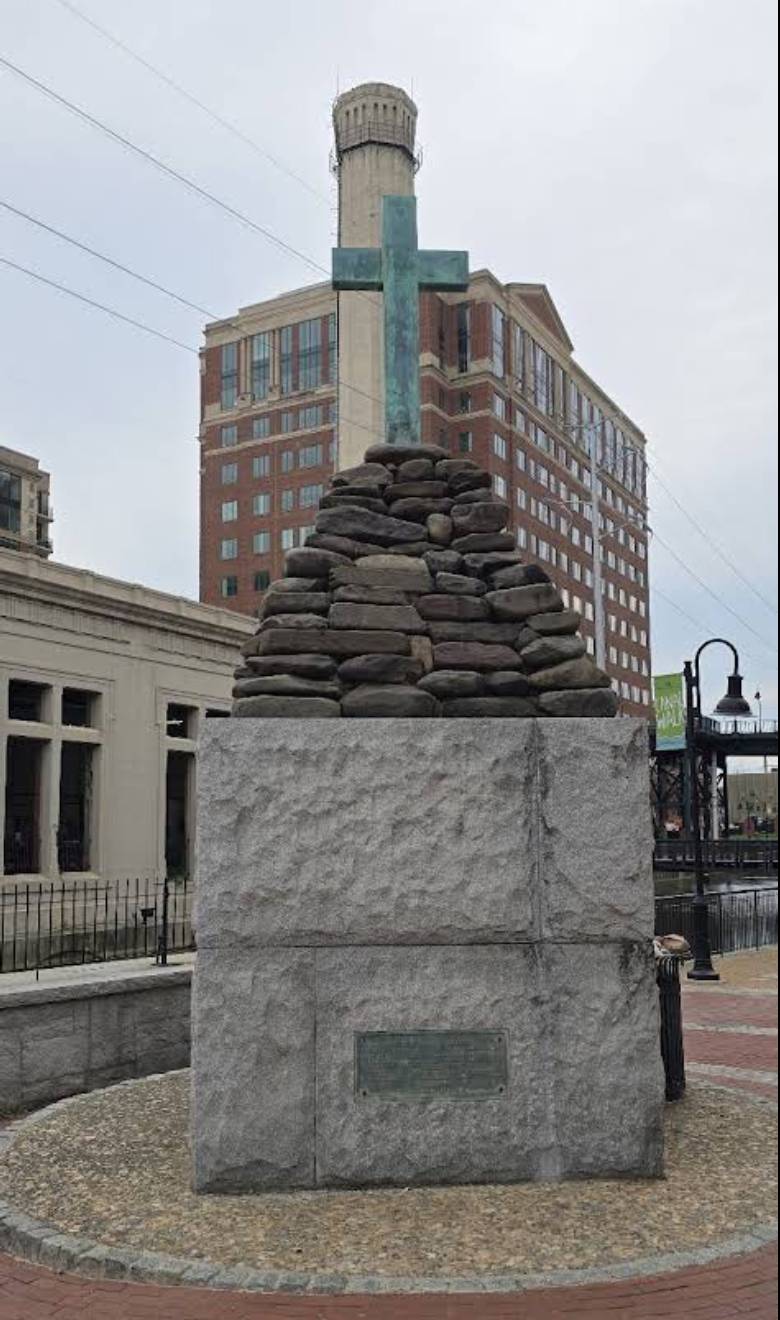
Most monuments tell you what happened at a given spot This one asks you to think about a moment that happened somewhere in the landscape of the falls of the James — and about how cities later choose to pin that memory down.
In late May 1607, only days after the English founded Jamestown, Christopher Newport sailed upriver with other colonists, including John Smith and George Percy. When they reached the falls of the James in present-day Richmond on May 24, 1607, they erected a cross and proclaimed King James’s claim to the river. Encyclopedia Virginia quotes George Percy’s account that they “set up a Crosse at the head of this River,” while the current marker by the Canal Walk says the cross bore the inscription “Jacobus Rex 1607.”
What was really happening
This was not just a religious gesture. It was a claim of possession — symbolic, political, and strategic. The English were exploring for resources and for a route inland, and the falls mattered because they marked the head of navigation and a hinge point between Tidewater and the Piedmont. Richmond’s later existence is tied to exactly that geography.
The original act was improvised and temporary: a wooden cross in a river landscape full of Indigenous power, diplomacy, and uncertainty. The monument came much later. The present stone memorial was presented to the City of Richmond in 1907 by the Association for the Preservation of Virginia Antiquities during the Jamestown tercentenary era, and today it stands on the Riverfront Canal Walk near 12th and Byrd.
The Newport Cross points to first-contact Richmond — the moment the English reached the falls and tried to define the place in their own terms. But it also reveals 1907 Richmond, a city deciding which origin story it wanted to monumentalize, and how. The monument is about 1607, but it also very much belongs to the memorial culture of the early 20th century.
Notice how out-of-time it feels on the Canal Walk. Around it are canals, flood-control infrastructure, downtown development, bike traffic, and public history panels. And in the middle of that is a monument to a brief act of colonial claiming at the falls more than three centuries earlier. It’s one of those Richmond places where the real subject is not just the past event, but the layering of pasts.
TruePlaces note
This is not the original cross. It’s the city’s memory of the cross — and that may be the more interesting object.