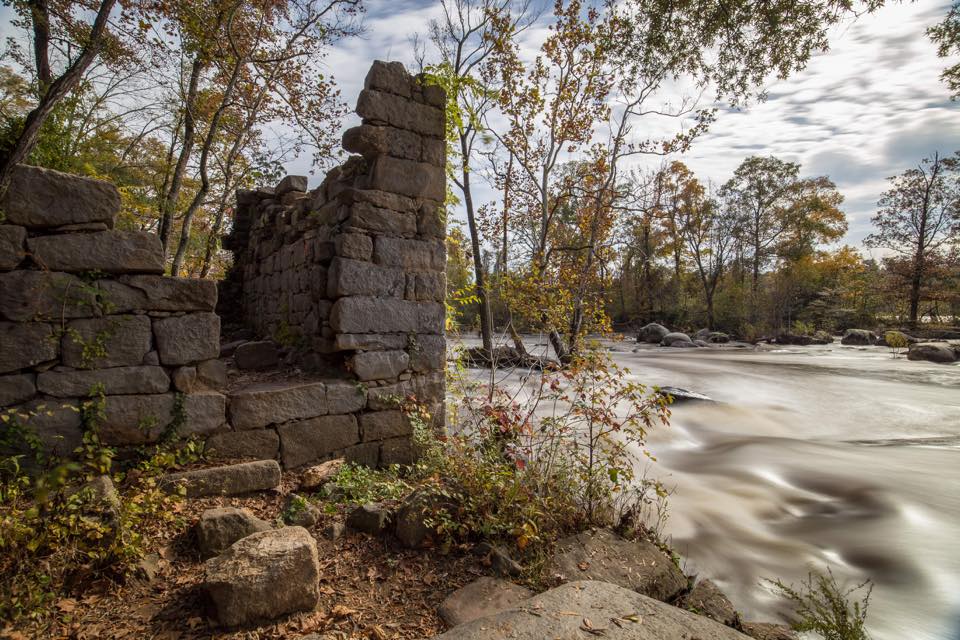
Where the James River narrows and quickens west of Richmond, a column of hand-cut granite rises from the riverbank like a broken finger pointing at the sky. This is all that remains of Foushee Mill — a grist mill that once turned the river's raw power into flour, cornmeal, and a livelihood for the families who worked its stones.

One Minute Wonder
A 60-second tour of this True Place
Watch the video
1:00

Built on the Fall Line

The fall line — that geological seam where the hard rock of the Piedmont drops into the soft sediments of the coastal plain — gave Richmond its reason for being. Ships couldn't pass the rapids, so cargo had to be unloaded, stored, and resold. But the same churning water that stopped navigation was a gift to millers. By the early 1800s, the banks of the James through Richmond were crowded with mills of every kind: grist mills, sawmills, paper mills, iron works.

Foushee Mill was among them. Built sometime in the 1830s, it sat at a bend in the river where the current ran fast and reliable. The Foushee family — whose name also graces a downtown Richmond street — operated the mill for decades, grinding wheat and corn for a growing city that was hungry in every sense.

The ruins don't announce themselves. You come around a bend in the trail and suddenly the forest floor turns to cut stone, and the river sounds different — faster, channeled by walls that haven't stood in a hundred and fifty years.

Field notes, October 2024

War and Water

The Civil War didn't spare the mill, but it wasn't the final blow. Richmond's industrial corridor along the James was a target of Union strategy throughout the war, and many mills were damaged or destroyed. Foushee Mill survived the conflict in diminished form, only to face an adversary more relentless than any army: the river itself.

A series of devastating floods in the 1870s — the kind of high water events that reshape riverbeds and rearrange the landscape — finally did what four years of war could not. The mill was destroyed, its machinery scattered downstream, its walls toppled into the current. What remained was slowly reclaimed by the forest.

What You'll Find Today

The ruins are modest but striking. A single stone column — perhaps fifteen feet tall — stands near the water's edge, its granite blocks still precisely fitted after nearly two centuries. Scattered foundation stones trace the outline of what was once the mill floor. In low water, you can see the remnants of the mill race, the channel that once directed the river's flow through the building.

The setting is what elevates the site from curiosity to something closer to art. The column stands at the edge of a small rapid, so the sound of moving water is constant. In autumn, when the sycamores and maples along the bank turn gold and the river runs clear, the contrast between the warm stone and the cold water is almost theatrical. It's the kind of place that makes you stand still for a while.

Getting there is straightforward. The ruins are accessible from the north bank trail system in the James River Park System. Park at the Huguenot Flatwater access point and walk east along the river trail for roughly half a mile. The column is visible from the trail — you can't miss it once you know to look.